


25 июля 2011 МФД-ИнфоЦентр | Архив
Поразительный факт о том, где создаются рабочие места в Америке вытекает из исследования, которое провели несколько американских известных экономистов.
Is There Hope for the Unemployed?
Ученые разбили экономику США на сектора, продукция которых торгуется за пределами США (the tradable sectors) и являются объектом конкуренции со стороны иностранных производителей, и сектора, продукция которых не торгуется за границами (the nontradable sectors).
В торгуемую категорию попали промышленные изделия, сельскохозяйственные продукты, сырьевые материалы и финансовые услуги, консалтинг, образование, компьютерные и другие технические услуги. В неторгуемом секторе преобладают государственные служащие, медицина, ритейл, строительство, рестораны и большая часть юридических услуг.
Авторы затем исследовали, какую занятость и добавочную стоимость на работника на работника давали оба этих сектора два последних десятилетия: с 1990 по 2008 год.
Они получили следующий ошеломляющий результат:
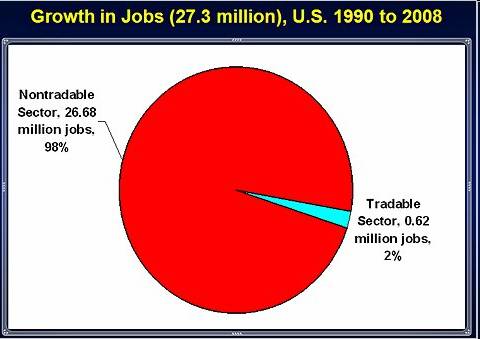
Из 27,3 млн. рабочих мест, созданных в американской экономике с 1990 по 2008 год, только 662000 было создано в торгуемом конкурентном секторе. Это составляет всего 2,3 % от общего числа рабочих мест, созданных в американской экономике.
Концепция цепочки добавленной стоимости является фундаментальной для понимания влияния глобализации на американскую экономику. Эта цепочка для каждого продукта состоит из ряда дискретных шагов от разработки и создания дизайна до завершающих продаж, включая транспортировку и маркетинг.
Так например, iPad от компании Apple разработан и сконструирован высококвалифицированными сотрудниками компании в США, но само устройство собирается тайваньской компанией Foxconn на предприятиях в Китае.
Имея розничную цену в 499 долларов, Apple тратит порядка 291 доллара на компоненты, как правило производимые в других странах. Остается 208 долларов или примерно 42% от розничной стоимости устройства.
iPad добавляет значительно больше в ВВП страны, чем в обеспечение занятости ее населения. Он создает несколько высокооплачиваемых рабочих мест в Америке, но совсем не добавляет рабочих мест в других сегментах занятости.
Последние годы технические инновации не увеличивают, а уменьшают число рабочих мест в США.
Проблема для Америки, что так называемые развивающиеся страны - а именно Китай, Бразилия и Индия – начинают проникать в те сегменты цепочки добавленной стоимости, в которых до недавнего времени безраздельно властвовали развитые экономики.
Симбиоз двух глобальных стратегий, о котором я подробно написал в статье, привел к катастрофическим последствиям для американской экономики.
Азиатская коммерческая стратегия и стратегия доллара США как резервной валюты, обе были сконцентрированы на глобальной торговле. США, как экономика на 70% состоящая из потребления, требовала дешевого финансирования, чтобы сохранить ее ненасытное потребление. Азия требовалось потребление, чтобы абсорбировать ее растущий экспорт.
Корпорации США видели оффшоризацию, аутсорсинг, размещение производства в выгодном регионе как главные пути повышения производительности. Стратегия азиатской коммерции предложила американским корпорациям возможность значительно увеличить производительность, в то время как Азии требовалось проникновение в каждый растущий и крупный рыночный сегмент. Американские корпорации несли ноу-хау, брэндинг и капитал в азиатские экономики, которые отчаянно нуждались во всех этих инструментах, чтобы обеспечить занятость необладающего какими-либо профессиональными навыками населения, увеличить стандарты жизни и уменьшить существующее и потенциально возможное социальное недовольство..
Эти две стратегии работали в гармонии, поскольку питали и поддерживали друг друга. однако сегодня чрезмерное количество долга и неспособность в ближайшем будущем его обслуживать приводит этот симбиоз благополучия к завершению.
Теперь Америка будет пожинать плоды своего беззаботного поведения; неизбежно снижение уровня жизни населения и оно уже идет.
На мой взгляд, процесс потери конкурентных преимуществ для Америки уже принял необратимый характер и уже привел к смене рыночной парадигмы в США ( контроль крупного капитала за всеми сферами) , а в дальнейшем приведет и к сильным социальным потрясениям
Что-то не совсем ладно с этим новым планом помощи Греции
Что-то не совсем ладно с этим новым планом помощи Греции. Эйфория как-то быстро прошла, CDS и доходности облигаций проблемных стран Европы пошли вверх.
Почему так происходит?
Вот некоторые скептические заметки от Jacques Cailloux и его команды из RBS
Греческий план помощи детализирован, продолжение кризиса очень вероятно.
Сохраняются сомнения относительно траектории экономики и способности получить доходы от приватизации сколько-нибудь близкие к ожидаемым
Набор инструментов для достойного ответа на распространение кризиса по еврозоне иссяк.
Создано три новых инструмента:
•Предупредительная программа
•Механизм кредитования для рекапитализации банков для незадействованных в программе стран
•Программа по покупке облигаций на вторичном рынке
However, the level of detail provided is low, making it hard at this stage to really tell how the new tools will work in practice and how efficient they will end up being. In particular, there is insufficient information available to tell how preventive those tools will end up being deployed and this is related to the lack of clarity surrounding the so called “appropriate conditionality” that will be imposed on member countries accessing these new help mechanisms
Однако уровень детализации мал и непонятно, как это все будет работать.
Средства хороши, но не хватает «огневой мощи»
Nice tools but no firing power: In our view a key limitation of the announcement is that it did not address the size of the EFSF. We have recently argued that a prerequisite to increase the flexibility of the EFSF was to increase very significantly its size with a view of ultimately having a lending capacity of around Eur2trn. Indeed, under the amended EFSF which will aim at having a lending capacity of Eur440bn, and given current and likely commitments, the EFSF will be left with a little more than Eur300bn of lending and or buying capacity – a too small amount to restore investor’s confidence that the euro area has once and for all dealt with its sovereign crisis. The crisis will in our view linger with markets likely to test the EFSF firepower
Nice tools but no firing power: In our view a key limitation of the announcement is that it did not address the size of the EFSF. We have recently argued that a prerequisite to increase the flexibility of the EFSF was to increase very significantly its size with a view of ultimately having a lending capacity of around Eur2trn. Indeed, under the amended EFSF which will aim at having a lending capacity of Eur440bn, and given current and likely commitments, the EFSF will be left with a little more than Eur300bn of lending and or buying capacity – a too small amount to restore investor’s confidence that the euro area has once and for all dealt with its sovereign crisis. The crisis will in our view linger with markets likely to test the EFSF firepower
Полный текст заявления евросаммита по Греции
Решил, что все-таки полезно будет добавить полный текст заявления евросаммита по Греции; уж очень важный документ. Его необходимо иметь под рукой.
Сcылка в комментарии, поскольку редактор записи не воспринимает ссылки, закачивающиеся на pdf
Заявление следовало бы перевести, но у меня нет на это время. Если где-нибудь увидите хороший перевод, напишите, пожалуйста, ссылочку внизу. А пока выделю в нем самые ключевые фразы.
Для нас, для трейдеров, самым важным является пункт №7:
7. To improve the effectiveness of the EFSF and address contagion, we agree to increase the flexibility of the EFSF, allowing it to:
- intervene on the basis of a precautionary program, with adequate conditionality;
- finance recapitalization of financial institutions through loans to governments including in non program countries;
- intervene in the secondary markets on the basis of an ECB analysis recognizing the existence of exceptional circumstances and a unanimous decision of the EFSF Member States.
Особенно последний подпункт: я его выделил.
Что это означает? Это означает, что на рынке возникли предпосылки для появления еще одного очень крупного кукловода в лице EFSF.
Поскольку, проводя интервенции на вторичном рынке европейских облигаций, они будут оказывать влияние и на евро и рынки рискованных активов. Сидят какие-то чиновники и решают, когда им проводить интервенции, а когда не проводить. На этом вполне можно зарабатывать, поскольку это очень сильный инсайд.
Будет ли это координироваться с действиями ФРС ? Возможно. В последнее время центральные банки часто координируют свои действия.
Напомню, что для вступления в силу это положение должно быть одобрено рядом европейских парламентов (может быть и каких-то других пунктов). Это займет по некоторым оценкам порядка 4 месяцев.
STATEMENT BY THE HEADS OF STATE OR GOVERNMENT OF THE EURO AREA
AND EU INSTITUTIONS
We reaffirm our commitment to the euro and to do whatever is needed to ensure the financial
stability of the euro area as a whole and its Member States. We also reaffirm our determination to reinforce convergence, competitiveness and governance in the euro area. Since the beginning of the sovereign debt crisis, important measures have been taken to stabilize the euro area, reform the rules and develop new stabilization tools. The recovery in the euro area is well on track and the euro is based on sound economic fundamentals. But the challenges at hand have shown the need for more far reaching measures.
Today, we agreed on the following measures:
Greece:
1. We welcome the measures undertaken by the Greek government to stabilize public finances
and reform the economy as well as the new package of measures including privatisation
recently adopted by the Greek Parliament. These are unprecedented, but necessary, efforts to
bring the Greek economy back on a sustainable growth path. We are conscious of the efforts
that the adjustment measures entail for the Greek citizens, and are convinced that these
sacrifices are indispensable for economic recovery and will contribute to the future stability
and welfare of the country.
2. We agree to support a new programme for Greece and, together with the IMF and the
voluntary contribution of the private sector, to fully cover the financing gap. The total official
financing will amount to an estimated 109 billion euro. This programme will be designed,
notably through lower interest rates and extended maturities, to decisively improve the debt
sustainability and refinancing profile of Greece. We call on the IMF to continue to contribute
to the financing of the new Greek programme. We intend to use the EFSF as the financing
vehicle for the next disbursement. We will monitor very closely the strict implementation of
the programme based on the regular assessment by the Commission in liaison with the ECB
and the IMF.
3. We have decided to lengthen the maturity of future EFSF loans to Greece to the maximum
extent possible from the current 7.5 years to a minimum of 15 years and up to 30 years with a
grace period of 10 years. In this context, we will ensure adequate post programme monitoring.
We will provide EFSF loans at lending rates equivalent to those of the Balance of Payments
facility (currently approx. 3.5%), close to, without going below, the EFSF funding cost. We
also decided to extend substantially the maturities of the existing Greek facility. This will be
accompanied by a mechanism which ensures appropriate incentives to implement the
programme.
4. We call for a comprehensive strategy for growth and investment in Greece. We welcome the
Commission’s decision to create a Task Force which will work with the Greek authorities to
target the structural funds on competitiveness and growth, job creation and training. We will
mobilise EU funds and institutions such as the EIB towards this goal and relaunch the Greek
economy. Member States and the Commission will immediately mobilize all resources
necessary in order to provide exceptional technical assistance to help Greece implement its
reforms. The Commission will report on progress in this respect in October.
5. The financial sector has indicated its willingness to support Greece on a voluntary basis
through a menu of options further strengthening overall sustainability. The net contribution of
the private sector is estimated at 37 billion euro.1 Credit enhancement will be provided to
underpin the quality of collateral so as to allow its continued use for access to Eurosystem
liquidity operations by Greek banks. We will provide adequate resources to recapitalise Greek
banks if needed.
1 Taking into account the cost of credit enhancement for the period 2011-2014. In addition, a
debt buy back programme will contribute to 12.6 billion euro, bringing the total to 50 billion
euro. For the period 2011-2019, the total net contribution of the private sector involvement is
estimated at 106 billion euro.
Private sector involvement:
6. As far as our general approach to private sector involvement in the euro area is concerned, we
would like to make it clear that Greece requires an exceptional and unique solution.
7. All other euro countries solemnly reaffirm their inflexible determination to honour fully their
own individual sovereign signature and all their commitments to sustainable fiscal conditions
and structural reforms. The euro area Heads of State or Government fully support this
determination as the credibility of all their sovereign signatures is a decisive element for
ensuring financial stability in the euro area as a whole.
Stabilization tools:
8. To improve the effectiveness of the EFSF and of the ESM and address contagion, we agree to
increase their flexibility linked to appropriate conditionality, allowing them to:
- act on the basis of a precautionary programme;
- finance recapitalisation of financial institutions through loans to governments including
in non programme countries ;
- intervene in the secondary markets on the basis of an ECB analysis recognizing the
existence of exceptional financial market circumstances and risks to financial stability
and on the basis of a decision by mutual agreement of the EFSF/ESM Member States,
to avoid contagion.
We will initiate the necessary procedures for the implementation of these decisions as soon as
possible.
9. Where appropriate, a collateral arrangement will be put in place so as to cover the risk arising
to euro area Member States from their guarantees to the EFSF.
Fiscal consolidation and growth in the euro area:
10. We are determined to continue to provide support to countries under programmes until they
have regained market access, provided they successfully implement those programmes. We
welcome Ireland and Portugal's resolve to strictly implement their programmes and reiterate
our strong commitment to the success of these programmes. The EFSF lending rates and
maturities we agreed upon for Greece will be applied also for Portugal and Ireland. In this
context, we note Ireland's willingness to participate constructively in the discussions on the
Common Consolidated Corporate Tax Base draft directive (CCCTB) and in the structured
discussions on tax policy issues in the framework of the Euro+ Pact framework.
11. All euro area Member States will adhere strictly to the agreed fiscal targets, improve
competitiveness and address macro-economic imbalances. Public deficits in all countries
except those under a programme will be brought below 3% by 2013 at the latest. In this
context, we welcome the budgetary package recently presented by the Italian government
which will enable it to bring the deficit below 3% in 2012 and to achieve balance budget in
2014. We also welcome the ambitious reforms undertaken by Spain in the fiscal, financial and
structural area. As a follow up to the results of bank stress tests, Member States will provide
backstops to banks as appropriate.
12. We will implement the recommendations adopted in June for reforms that will enhance our
growth. We invite the Commission and the EIB to enhance the synergies between loan
programmes and EU funds in all countries under EU/IMF assistance. We support all efforts to
improve their capacity to absorb EU funds in order to stimulate growth and employment,
including through a temporary increase in co-financing rates.
Economic governance:
13. We call for the rapid finalization of the legislative package on the strengthening of the
Stability and Growth Pact and the new macro economic surveillance. Euro area members will
fully support the Polish Presidency in order to reach agreement with the European Parliament
on voting rules in the preventive arm of the Pact.
14. We commit to introduce by the end of 2012 national fiscal frameworks as foreseen in the
fiscal frameworks directive.
15. We agree that reliance on external credit ratings in the EU regulatory framework should be
reduced, taking into account the Commission's recent proposals in that direction, and we look
forward to the Commission proposals on credit ratings agencies.
16. We invite the President of the European Council, in close consultation with the President of
the Commission and the President of the Eurogroup, to make concrete proposals by October
on how to improve working methods and enhance crisis management in the eur
Материал подготовил ЧЕССПЛЕЙЕР
Is There Hope for the Unemployed?
Ученые разбили экономику США на сектора, продукция которых торгуется за пределами США (the tradable sectors) и являются объектом конкуренции со стороны иностранных производителей, и сектора, продукция которых не торгуется за границами (the nontradable sectors).
В торгуемую категорию попали промышленные изделия, сельскохозяйственные продукты, сырьевые материалы и финансовые услуги, консалтинг, образование, компьютерные и другие технические услуги. В неторгуемом секторе преобладают государственные служащие, медицина, ритейл, строительство, рестораны и большая часть юридических услуг.
Авторы затем исследовали, какую занятость и добавочную стоимость на работника на работника давали оба этих сектора два последних десятилетия: с 1990 по 2008 год.
Они получили следующий ошеломляющий результат:
Из 27,3 млн. рабочих мест, созданных в американской экономике с 1990 по 2008 год, только 662000 было создано в торгуемом конкурентном секторе. Это составляет всего 2,3 % от общего числа рабочих мест, созданных в американской экономике.
Концепция цепочки добавленной стоимости является фундаментальной для понимания влияния глобализации на американскую экономику. Эта цепочка для каждого продукта состоит из ряда дискретных шагов от разработки и создания дизайна до завершающих продаж, включая транспортировку и маркетинг.
Так например, iPad от компании Apple разработан и сконструирован высококвалифицированными сотрудниками компании в США, но само устройство собирается тайваньской компанией Foxconn на предприятиях в Китае.
Имея розничную цену в 499 долларов, Apple тратит порядка 291 доллара на компоненты, как правило производимые в других странах. Остается 208 долларов или примерно 42% от розничной стоимости устройства.
iPad добавляет значительно больше в ВВП страны, чем в обеспечение занятости ее населения. Он создает несколько высокооплачиваемых рабочих мест в Америке, но совсем не добавляет рабочих мест в других сегментах занятости.
Последние годы технические инновации не увеличивают, а уменьшают число рабочих мест в США.
Проблема для Америки, что так называемые развивающиеся страны - а именно Китай, Бразилия и Индия – начинают проникать в те сегменты цепочки добавленной стоимости, в которых до недавнего времени безраздельно властвовали развитые экономики.
Симбиоз двух глобальных стратегий, о котором я подробно написал в статье, привел к катастрофическим последствиям для американской экономики.
Азиатская коммерческая стратегия и стратегия доллара США как резервной валюты, обе были сконцентрированы на глобальной торговле. США, как экономика на 70% состоящая из потребления, требовала дешевого финансирования, чтобы сохранить ее ненасытное потребление. Азия требовалось потребление, чтобы абсорбировать ее растущий экспорт.
Корпорации США видели оффшоризацию, аутсорсинг, размещение производства в выгодном регионе как главные пути повышения производительности. Стратегия азиатской коммерции предложила американским корпорациям возможность значительно увеличить производительность, в то время как Азии требовалось проникновение в каждый растущий и крупный рыночный сегмент. Американские корпорации несли ноу-хау, брэндинг и капитал в азиатские экономики, которые отчаянно нуждались во всех этих инструментах, чтобы обеспечить занятость необладающего какими-либо профессиональными навыками населения, увеличить стандарты жизни и уменьшить существующее и потенциально возможное социальное недовольство..
Эти две стратегии работали в гармонии, поскольку питали и поддерживали друг друга. однако сегодня чрезмерное количество долга и неспособность в ближайшем будущем его обслуживать приводит этот симбиоз благополучия к завершению.
Теперь Америка будет пожинать плоды своего беззаботного поведения; неизбежно снижение уровня жизни населения и оно уже идет.
На мой взгляд, процесс потери конкурентных преимуществ для Америки уже принял необратимый характер и уже привел к смене рыночной парадигмы в США ( контроль крупного капитала за всеми сферами) , а в дальнейшем приведет и к сильным социальным потрясениям
Что-то не совсем ладно с этим новым планом помощи Греции
Что-то не совсем ладно с этим новым планом помощи Греции. Эйфория как-то быстро прошла, CDS и доходности облигаций проблемных стран Европы пошли вверх.
Почему так происходит?
Вот некоторые скептические заметки от Jacques Cailloux и его команды из RBS
Греческий план помощи детализирован, продолжение кризиса очень вероятно.
Сохраняются сомнения относительно траектории экономики и способности получить доходы от приватизации сколько-нибудь близкие к ожидаемым
Набор инструментов для достойного ответа на распространение кризиса по еврозоне иссяк.
Создано три новых инструмента:
•Предупредительная программа
•Механизм кредитования для рекапитализации банков для незадействованных в программе стран
•Программа по покупке облигаций на вторичном рынке
However, the level of detail provided is low, making it hard at this stage to really tell how the new tools will work in practice and how efficient they will end up being. In particular, there is insufficient information available to tell how preventive those tools will end up being deployed and this is related to the lack of clarity surrounding the so called “appropriate conditionality” that will be imposed on member countries accessing these new help mechanisms
Однако уровень детализации мал и непонятно, как это все будет работать.
Средства хороши, но не хватает «огневой мощи»
Nice tools but no firing power: In our view a key limitation of the announcement is that it did not address the size of the EFSF. We have recently argued that a prerequisite to increase the flexibility of the EFSF was to increase very significantly its size with a view of ultimately having a lending capacity of around Eur2trn. Indeed, under the amended EFSF which will aim at having a lending capacity of Eur440bn, and given current and likely commitments, the EFSF will be left with a little more than Eur300bn of lending and or buying capacity – a too small amount to restore investor’s confidence that the euro area has once and for all dealt with its sovereign crisis. The crisis will in our view linger with markets likely to test the EFSF firepower
Nice tools but no firing power: In our view a key limitation of the announcement is that it did not address the size of the EFSF. We have recently argued that a prerequisite to increase the flexibility of the EFSF was to increase very significantly its size with a view of ultimately having a lending capacity of around Eur2trn. Indeed, under the amended EFSF which will aim at having a lending capacity of Eur440bn, and given current and likely commitments, the EFSF will be left with a little more than Eur300bn of lending and or buying capacity – a too small amount to restore investor’s confidence that the euro area has once and for all dealt with its sovereign crisis. The crisis will in our view linger with markets likely to test the EFSF firepower
Полный текст заявления евросаммита по Греции
Решил, что все-таки полезно будет добавить полный текст заявления евросаммита по Греции; уж очень важный документ. Его необходимо иметь под рукой.
Сcылка в комментарии, поскольку редактор записи не воспринимает ссылки, закачивающиеся на pdf
Заявление следовало бы перевести, но у меня нет на это время. Если где-нибудь увидите хороший перевод, напишите, пожалуйста, ссылочку внизу. А пока выделю в нем самые ключевые фразы.
Для нас, для трейдеров, самым важным является пункт №7:
7. To improve the effectiveness of the EFSF and address contagion, we agree to increase the flexibility of the EFSF, allowing it to:
- intervene on the basis of a precautionary program, with adequate conditionality;
- finance recapitalization of financial institutions through loans to governments including in non program countries;
- intervene in the secondary markets on the basis of an ECB analysis recognizing the existence of exceptional circumstances and a unanimous decision of the EFSF Member States.
Особенно последний подпункт: я его выделил.
Что это означает? Это означает, что на рынке возникли предпосылки для появления еще одного очень крупного кукловода в лице EFSF.
Поскольку, проводя интервенции на вторичном рынке европейских облигаций, они будут оказывать влияние и на евро и рынки рискованных активов. Сидят какие-то чиновники и решают, когда им проводить интервенции, а когда не проводить. На этом вполне можно зарабатывать, поскольку это очень сильный инсайд.
Будет ли это координироваться с действиями ФРС ? Возможно. В последнее время центральные банки часто координируют свои действия.
Напомню, что для вступления в силу это положение должно быть одобрено рядом европейских парламентов (может быть и каких-то других пунктов). Это займет по некоторым оценкам порядка 4 месяцев.
STATEMENT BY THE HEADS OF STATE OR GOVERNMENT OF THE EURO AREA
AND EU INSTITUTIONS
We reaffirm our commitment to the euro and to do whatever is needed to ensure the financial
stability of the euro area as a whole and its Member States. We also reaffirm our determination to reinforce convergence, competitiveness and governance in the euro area. Since the beginning of the sovereign debt crisis, important measures have been taken to stabilize the euro area, reform the rules and develop new stabilization tools. The recovery in the euro area is well on track and the euro is based on sound economic fundamentals. But the challenges at hand have shown the need for more far reaching measures.
Today, we agreed on the following measures:
Greece:
1. We welcome the measures undertaken by the Greek government to stabilize public finances
and reform the economy as well as the new package of measures including privatisation
recently adopted by the Greek Parliament. These are unprecedented, but necessary, efforts to
bring the Greek economy back on a sustainable growth path. We are conscious of the efforts
that the adjustment measures entail for the Greek citizens, and are convinced that these
sacrifices are indispensable for economic recovery and will contribute to the future stability
and welfare of the country.
2. We agree to support a new programme for Greece and, together with the IMF and the
voluntary contribution of the private sector, to fully cover the financing gap. The total official
financing will amount to an estimated 109 billion euro. This programme will be designed,
notably through lower interest rates and extended maturities, to decisively improve the debt
sustainability and refinancing profile of Greece. We call on the IMF to continue to contribute
to the financing of the new Greek programme. We intend to use the EFSF as the financing
vehicle for the next disbursement. We will monitor very closely the strict implementation of
the programme based on the regular assessment by the Commission in liaison with the ECB
and the IMF.
3. We have decided to lengthen the maturity of future EFSF loans to Greece to the maximum
extent possible from the current 7.5 years to a minimum of 15 years and up to 30 years with a
grace period of 10 years. In this context, we will ensure adequate post programme monitoring.
We will provide EFSF loans at lending rates equivalent to those of the Balance of Payments
facility (currently approx. 3.5%), close to, without going below, the EFSF funding cost. We
also decided to extend substantially the maturities of the existing Greek facility. This will be
accompanied by a mechanism which ensures appropriate incentives to implement the
programme.
4. We call for a comprehensive strategy for growth and investment in Greece. We welcome the
Commission’s decision to create a Task Force which will work with the Greek authorities to
target the structural funds on competitiveness and growth, job creation and training. We will
mobilise EU funds and institutions such as the EIB towards this goal and relaunch the Greek
economy. Member States and the Commission will immediately mobilize all resources
necessary in order to provide exceptional technical assistance to help Greece implement its
reforms. The Commission will report on progress in this respect in October.
5. The financial sector has indicated its willingness to support Greece on a voluntary basis
through a menu of options further strengthening overall sustainability. The net contribution of
the private sector is estimated at 37 billion euro.1 Credit enhancement will be provided to
underpin the quality of collateral so as to allow its continued use for access to Eurosystem
liquidity operations by Greek banks. We will provide adequate resources to recapitalise Greek
banks if needed.
1 Taking into account the cost of credit enhancement for the period 2011-2014. In addition, a
debt buy back programme will contribute to 12.6 billion euro, bringing the total to 50 billion
euro. For the period 2011-2019, the total net contribution of the private sector involvement is
estimated at 106 billion euro.
Private sector involvement:
6. As far as our general approach to private sector involvement in the euro area is concerned, we
would like to make it clear that Greece requires an exceptional and unique solution.
7. All other euro countries solemnly reaffirm their inflexible determination to honour fully their
own individual sovereign signature and all their commitments to sustainable fiscal conditions
and structural reforms. The euro area Heads of State or Government fully support this
determination as the credibility of all their sovereign signatures is a decisive element for
ensuring financial stability in the euro area as a whole.
Stabilization tools:
8. To improve the effectiveness of the EFSF and of the ESM and address contagion, we agree to
increase their flexibility linked to appropriate conditionality, allowing them to:
- act on the basis of a precautionary programme;
- finance recapitalisation of financial institutions through loans to governments including
in non programme countries ;
- intervene in the secondary markets on the basis of an ECB analysis recognizing the
existence of exceptional financial market circumstances and risks to financial stability
and on the basis of a decision by mutual agreement of the EFSF/ESM Member States,
to avoid contagion.
We will initiate the necessary procedures for the implementation of these decisions as soon as
possible.
9. Where appropriate, a collateral arrangement will be put in place so as to cover the risk arising
to euro area Member States from their guarantees to the EFSF.
Fiscal consolidation and growth in the euro area:
10. We are determined to continue to provide support to countries under programmes until they
have regained market access, provided they successfully implement those programmes. We
welcome Ireland and Portugal's resolve to strictly implement their programmes and reiterate
our strong commitment to the success of these programmes. The EFSF lending rates and
maturities we agreed upon for Greece will be applied also for Portugal and Ireland. In this
context, we note Ireland's willingness to participate constructively in the discussions on the
Common Consolidated Corporate Tax Base draft directive (CCCTB) and in the structured
discussions on tax policy issues in the framework of the Euro+ Pact framework.
11. All euro area Member States will adhere strictly to the agreed fiscal targets, improve
competitiveness and address macro-economic imbalances. Public deficits in all countries
except those under a programme will be brought below 3% by 2013 at the latest. In this
context, we welcome the budgetary package recently presented by the Italian government
which will enable it to bring the deficit below 3% in 2012 and to achieve balance budget in
2014. We also welcome the ambitious reforms undertaken by Spain in the fiscal, financial and
structural area. As a follow up to the results of bank stress tests, Member States will provide
backstops to banks as appropriate.
12. We will implement the recommendations adopted in June for reforms that will enhance our
growth. We invite the Commission and the EIB to enhance the synergies between loan
programmes and EU funds in all countries under EU/IMF assistance. We support all efforts to
improve their capacity to absorb EU funds in order to stimulate growth and employment,
including through a temporary increase in co-financing rates.
Economic governance:
13. We call for the rapid finalization of the legislative package on the strengthening of the
Stability and Growth Pact and the new macro economic surveillance. Euro area members will
fully support the Polish Presidency in order to reach agreement with the European Parliament
on voting rules in the preventive arm of the Pact.
14. We commit to introduce by the end of 2012 national fiscal frameworks as foreseen in the
fiscal frameworks directive.
15. We agree that reliance on external credit ratings in the EU regulatory framework should be
reduced, taking into account the Commission's recent proposals in that direction, and we look
forward to the Commission proposals on credit ratings agencies.
16. We invite the President of the European Council, in close consultation with the President of
the Commission and the President of the Eurogroup, to make concrete proposals by October
on how to improve working methods and enhance crisis management in the eur
Материал подготовил ЧЕССПЛЕЙЕР
Не является индивидуальной инвестиционной рекомендацией | При копировании ссылка обязательна | Нашли ошибку - выделить и нажать Ctrl+Enter | Жалоба