


2 августа 2011 МФД-ИнфоЦентр | Архив
Mark Meckler, один из соучредителей «чайной» партии, дал интервью журналу Шпигель. Само по себе необычно, когда ведущий в Германии журнал берет интервью у одного из самых жестких критиков президента Обамы.
По-видимому, европейцы решили напомнить Америке про то, что у тех хватает своих проблем.
We Have Compromised Our Way Into Disaster
Вот некоторые из высказываний Марка Меклера:
Дефолт – это ложная угроза. Мы имеем 220 млрд. долларов доходов ежемесячно, а наше обслуживание долга обходиться всего в 20 млрд. долларов. Единственный путь к дефолту – это если президент сделает безответственный выбор и не станет платить по долгам.
Говорить о том, что эти дебаты повредили нашему имиджу – это абсурд. Это одни из наиболее ответственных дебатов... Всему миру следует посмотреть на то, что происходит в США, как на модель будущих событий, которые произойдут в их стране.
Компромиссы. которые мы заключили, поставят страну на край гибели. В настоящий момент американское правительство тратит 44 цента из каждого доллара на выплату процентов. Компромисс ведет нас к бедствию. Не один из предложенных планов не имеет реальных сокращений – только одни обещания. Реальность в том, что законодательно один состав конгресса не может запретить другому составу тратить, так что все эти обещания – это ложь. Нам нужны реальные и немедленные сокращения.
Посмотрите на план. Он предлагает 22 млрд. долларов сокращений в будущем году. Это смехотворно мало. Это тоже самое, что прекратить тратить в пятницу ночью и затем вернуться к обычному порядку расходования в понедельник.
Мы очень много беспокоимся о краткосрочных проблемах, но совсем забываем о долгосрочных перспективах нашей нации. Посмотрите на то, что происходит в Европе. Испания – это полное несчастье. Они имеют больше пустующих домов, чем у нас здесь. И это всего при 40 млн. населения. Италия – это полное несчастье. Европа идет по тому же пути, что и Америка; только многие страны уже далеко впереди и при этом не предпринимают правильных действий
Если Америке снизят рейтинг
Еще в четверг Goldman Sachs выпустил записку для своих клиентов о тех последствиях, которые будет иметь понижение рейтинга США.
Хотя я считаю сейчас это маловероятным, тем не менее полезно быть в курсе, что последует, если это все-таки случится.
РАНО ИЛИ ПОЗДНО ЭТО ВСЕ-РАВНО СЛУЧИТСЯ.
Поэтому я возвращаюсь к этому важному вопросу.
Это будет совсем непохоже на то, что было в Японии
Ян Хатциус: «В истории еще не было такого момента, который можно было бы поставить рядом с текущей ситуацией».
О критериях, которые будут использовать агентства при принятии решения о понижении рейтинга.
We expect the rating agencies will use two primary criteria to evaluate the eventual debt limit agreement:
•Debt limit uncertainty: Proposals that increase the debt limit for a longer period appear to have a better chance of leading to more positive rating outcomes, by reducing uncertainty regarding interest and principal payments. This implies that an increase in the debt limit of $2.4 trillion that occurs in two stages would, all things being equal, pose more risk to the US AAA rating than a single increase of $2.4 trillion.
•Medium-term fiscal stabilization of debt trajectory: In order to maintain their AAA ratings and return to a stable outlook, S&P and Moody’s have indicated that a deficit reduction package of roughly $4 trillion over ten years would need to be agreed to by Congress. The primary measure of stability in debt dynamics that the rating agencies are likely to look for is stabilization of the debt-to-GDP ratio by mid-decade. This is similar to the G20 declaration in 2010 that debt-to-GDP ratios should be stabilized or in decline by 2016. In practice, this should essentially require the primary deficit to be eliminated by that time. In the US, this would imply a 6% of GDP improvement in the structural fiscal balance over five years.
The upshot is that the ratings reaction to the plan that will hopefully be enacted in coming days is likely to depend not only on the headline savings achieved, but also on the balance between the uncertainty that the chosen enforcement mechanism creates on the one hand, and the credibility that it provides to the reform process on the other hand. Unfortunately, the relative importance of these factors to the rating agencies (and S&P in particular) is unclear, as is how much other "soft" factors – such as the breadth of political support for the agreement for the agreement – will weigh in their decision
Это будет связано также с тем, сколько неопределенности останется в ситуации с госдолгом США после повышения лимита госдолга
Какие последствия видит GS
Прежде всего GS считает, что понижение рейтинга не приведет к продажам казначейских бумаг
A downgrade should not force sale of Treasuries
If one of the rating agencies does decide to downgrade the US sovereign rating, we see three main direct effects:
1.Knock-on downgrades. Rating agencies are likely to downgrade the ratings of some issuers that are closely linked or directly backed by the US government. The most obvious candidates are Fannie Mae and Freddie Mac, which are under conservatorship and rely on federal financial support. Fannie and Freddie MBS benefit from an implicit guarantee but are not rated, though they could still be affected. Ginnie Mae securities on the other hand, are directly backed by the federal government, and would likely be downgraded. AAA-rated Federal Home Loan Banks (FHLBs) don't rely on federal capital or financing, but would also be downgraded in the event of a sovereign downgrade, according to S&P. AAA-rated insurers would as well, in light of S&P's policy of not rating insurers higher than sovereigns of the same jurisdiction. Highly rated bank holding companies and bank subsidiaries could also be subject to downgrade, since some benefit from ratings "lift" above the banks standalone strength; while S&P has indicated that it would not immediately downgrade any banks or broker dealers in relation to a sovereign downgrade, Moody's has indicated that it might in the event that it downgraded its US sovereign rating.
2.Collateral effects. The primary issue here is the repo market, since AA-rated Treasury and agency securities could face slightly higher haircuts, either as a result of a possible downgrade or as an indirect result of volatility that results from a downgrade. In the broader repo market, Treasuries are the dominant form of collateral, though in the tri-party repo market, agency MBS and CMOs comprise a greater share of the total collateral used (roughly 40%) than Treasuries (30%) and GSE debt (9%) do. In the event of a downgrade, it is reasonable to expect that the haircut on these securities might rise by up to one percentage point (the New York Fed estimates the median haircut for Treasuries and agency debt and MBS is currently 2%). Treasuries, and to a lesser extent agency securities, are also used for derivatives margining, though the aggregate amounts are much smaller. This would cause a modest contraction in available funding; 1% of an estimated $1.7 trillion tri-party repo market, of which 80% relies on government securities, would reduce funding using current collateral by $14 billion.
3.Capital requirements and investment mandates. In general, it is unlikely that a downgrade would result in significant pressure on regulated entities to shift assets out of Treasuries or agency securities, though it is conceivable that there may be some isolated areas where this could occur. In general, as shown in the table below, regulatory requirements often treat government securities as a separate asset class. Moreover, regulatory constraints typically would not come into play if a downgrade were only of one or two notches, to the AA+ or AA level. Likewise, a downgrade by only one rating agency is less likely to trigger such a reaction than a downgrade by two rating agencies. What happens to the significant portion of Treasury and agency securities held by foreign investors is a more complex question given a diversity of mandates – a few of these might rely on ratings – versus the deeper liquidity of the US government securities compared with any alternative investment, and the fact that a good deal of foreign holdings are the byproduct of the buildup of reserves in growth economies, particularly in Asia, that are generating large current account surpluses
Как повлияет понижение рейтинга США на цены на активы
With those warnings in mind, we suspect we would see the following reactions to a US downgrade:
1.A drop in equity markets, but probably a modest one. Equities usually but not always dropped on the day of downgrade; a further drift down of a few percent over the subsequent month was typical. But the average drop in the equity market was less than 1% on the day, and there were exceptions over both the 1-day and 1-month horizons. Part of the reason for this—and the often mild moves in other asset classes—is undoubtedly that the debt issues had long been on the market’s radar and the potential for a downgrade was known, though we had trouble finding a clear pattern in the behavior of equities in the months leading up to the downgrade.
2.Some weakening in the currency. The yen dropped by more than 1% versus the dollar on two of the downgrade episodes; moves in the other cases were very small. Given the large foreign holdings of Treasuries, it would not be surprising to see a somewhat bigger effect on the dollar in the event of a US downgrade, although we would be surprised by a move of more than a few percent. The effect on the currency could also be mitigated by repatriations of foreign assets to increase cash holdings.
3.A steepening of the yield curve and a cheapening of Treasuries relative to OIS. The Japan, Canada, and Spain episodes showed no clear pattern in ten-year yields or spreads to US Treasuries. This may be because downgrades imply two opposing forces: a heightened premium for holding government debt, which pushes yields higher, but more pressure for fiscal austerity, which would slow growth (at least in the near term) and pushes yields lower. This tug-of-war was evident earlier this year when Standard & Poor’s changed its US rating outlook to negative: ten-year Treasury yields ended the day little changed. Standard & Poor’s has indicated an expectation of a 25-50bp increase in “long-term” US interest rates in the event of a downgrade; this is certainly possible at the very long end of the curve,, but we suspect the impact on the ten-year note would be smaller, at least initially. One clearer implication is a curve steepening, since the impact of austerity is disproportionately felt at the front end of the curve whereas the heightened risk premium is most significant at the long end. This effect could be reversed (i.e., more front-end weakness) if the US were to go into a "technical default," but we view this as a very remote scenario. Relative to the expected path of short-term interest rates (i.e., OIS), we would expect Treasuries to cheapen somewhat further (currently, 10-year Treasuries trade 20bp above corresponding maturity OIS).
4.Some weakness in the financials sector. In the event of a US sovereign downgrade, S&P has indicated that AAA insurers, the GSEs, and the Federal Home Loan Banks would be downgraded as well. Although a recent S&P statement suggested that “banks and broker-dealers wouldn’t likely suffer any immediate ratings downgrades,” an increased premium on sovereign debt could result in some indirect impact on debt and equity of financial firms beyond those insurers directly affected
Все это важно, но у меня нет времени переводить.
Если понижение рейтинга случится в ближайшие 3-4 недели, - пишет Ян Хатциус, то это повлечет за собой:
1.Падение рынков акций, хотя, возможно, и умеренное
2.Некоторую слабость в валюте
3.Кривая доходностей увеличит кривизну, а трежеря станут дешевле, чем overnight indexed swap (OIS)
4.Некоторая слабость в финансовом секторе
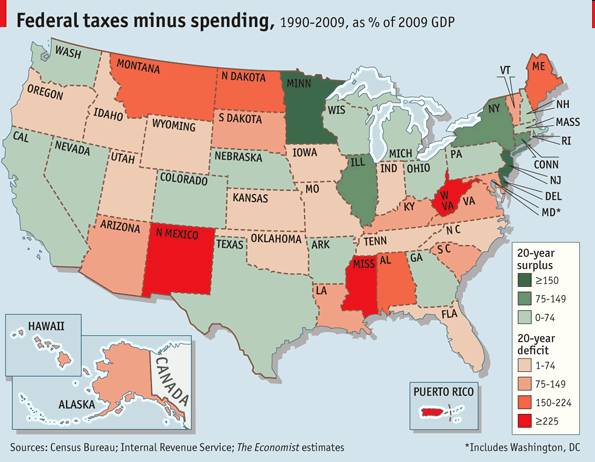
Собираемые федеральные налоги и затраты в США по штатам
Какие из американских штатов являются донорами, а какие акцепторами? Представление об этом дает следующая карта. На ней различным цветом выделено, какие штаты имеют профицит, а какие дефицит бюджета в % от ВВП за последние 20 лет.
Источник:
Здесь также имеется таблица с данными.
Интересно было бы посмотреть, как выглядит картина не за последние 20 лет, а последние 5 лет.
О финансовом кризисе штатов здесь
Как США выходят из рецессии
Данные по ВВП за второй квартал, опубликованные в пятницу, оказались обескураживающими: 1,3% вместо 1,7%. Но это, как говорится, полбеды.
Были пересмотрены в сторону понижения годовые данные по ВВП за 2008 и 2009 год: на 0,3% и 0,9% соответственно. И хотя данные за 2010 год были пересмотрены в сторону повышения, они не компенсировали этого снижения.
На графике внизу показано, как Америка выходит из нынешней рецессии 2007-2009 года и как она выходила из трех предыдущих рецессий (ВВП и уровень занятости).

До сих пор Америка еще не вышла на докризисный уровень не по ВВП, не по занятости.
Если данные по занятости на этой неделе окажутся хуже данных за прошлый месяц, уже можно будет говорить о приближении новой рецессии.
Материал подготовил ЧЕССПЛЕЙЕР
По-видимому, европейцы решили напомнить Америке про то, что у тех хватает своих проблем.
We Have Compromised Our Way Into Disaster
Вот некоторые из высказываний Марка Меклера:
Дефолт – это ложная угроза. Мы имеем 220 млрд. долларов доходов ежемесячно, а наше обслуживание долга обходиться всего в 20 млрд. долларов. Единственный путь к дефолту – это если президент сделает безответственный выбор и не станет платить по долгам.
Говорить о том, что эти дебаты повредили нашему имиджу – это абсурд. Это одни из наиболее ответственных дебатов... Всему миру следует посмотреть на то, что происходит в США, как на модель будущих событий, которые произойдут в их стране.
Компромиссы. которые мы заключили, поставят страну на край гибели. В настоящий момент американское правительство тратит 44 цента из каждого доллара на выплату процентов. Компромисс ведет нас к бедствию. Не один из предложенных планов не имеет реальных сокращений – только одни обещания. Реальность в том, что законодательно один состав конгресса не может запретить другому составу тратить, так что все эти обещания – это ложь. Нам нужны реальные и немедленные сокращения.
Посмотрите на план. Он предлагает 22 млрд. долларов сокращений в будущем году. Это смехотворно мало. Это тоже самое, что прекратить тратить в пятницу ночью и затем вернуться к обычному порядку расходования в понедельник.
Мы очень много беспокоимся о краткосрочных проблемах, но совсем забываем о долгосрочных перспективах нашей нации. Посмотрите на то, что происходит в Европе. Испания – это полное несчастье. Они имеют больше пустующих домов, чем у нас здесь. И это всего при 40 млн. населения. Италия – это полное несчастье. Европа идет по тому же пути, что и Америка; только многие страны уже далеко впереди и при этом не предпринимают правильных действий
Если Америке снизят рейтинг
Еще в четверг Goldman Sachs выпустил записку для своих клиентов о тех последствиях, которые будет иметь понижение рейтинга США.
Хотя я считаю сейчас это маловероятным, тем не менее полезно быть в курсе, что последует, если это все-таки случится.
РАНО ИЛИ ПОЗДНО ЭТО ВСЕ-РАВНО СЛУЧИТСЯ.
Поэтому я возвращаюсь к этому важному вопросу.
Это будет совсем непохоже на то, что было в Японии
Ян Хатциус: «В истории еще не было такого момента, который можно было бы поставить рядом с текущей ситуацией».
О критериях, которые будут использовать агентства при принятии решения о понижении рейтинга.
We expect the rating agencies will use two primary criteria to evaluate the eventual debt limit agreement:
•Debt limit uncertainty: Proposals that increase the debt limit for a longer period appear to have a better chance of leading to more positive rating outcomes, by reducing uncertainty regarding interest and principal payments. This implies that an increase in the debt limit of $2.4 trillion that occurs in two stages would, all things being equal, pose more risk to the US AAA rating than a single increase of $2.4 trillion.
•Medium-term fiscal stabilization of debt trajectory: In order to maintain their AAA ratings and return to a stable outlook, S&P and Moody’s have indicated that a deficit reduction package of roughly $4 trillion over ten years would need to be agreed to by Congress. The primary measure of stability in debt dynamics that the rating agencies are likely to look for is stabilization of the debt-to-GDP ratio by mid-decade. This is similar to the G20 declaration in 2010 that debt-to-GDP ratios should be stabilized or in decline by 2016. In practice, this should essentially require the primary deficit to be eliminated by that time. In the US, this would imply a 6% of GDP improvement in the structural fiscal balance over five years.
The upshot is that the ratings reaction to the plan that will hopefully be enacted in coming days is likely to depend not only on the headline savings achieved, but also on the balance between the uncertainty that the chosen enforcement mechanism creates on the one hand, and the credibility that it provides to the reform process on the other hand. Unfortunately, the relative importance of these factors to the rating agencies (and S&P in particular) is unclear, as is how much other "soft" factors – such as the breadth of political support for the agreement for the agreement – will weigh in their decision
Это будет связано также с тем, сколько неопределенности останется в ситуации с госдолгом США после повышения лимита госдолга
Какие последствия видит GS
Прежде всего GS считает, что понижение рейтинга не приведет к продажам казначейских бумаг
A downgrade should not force sale of Treasuries
If one of the rating agencies does decide to downgrade the US sovereign rating, we see three main direct effects:
1.Knock-on downgrades. Rating agencies are likely to downgrade the ratings of some issuers that are closely linked or directly backed by the US government. The most obvious candidates are Fannie Mae and Freddie Mac, which are under conservatorship and rely on federal financial support. Fannie and Freddie MBS benefit from an implicit guarantee but are not rated, though they could still be affected. Ginnie Mae securities on the other hand, are directly backed by the federal government, and would likely be downgraded. AAA-rated Federal Home Loan Banks (FHLBs) don't rely on federal capital or financing, but would also be downgraded in the event of a sovereign downgrade, according to S&P. AAA-rated insurers would as well, in light of S&P's policy of not rating insurers higher than sovereigns of the same jurisdiction. Highly rated bank holding companies and bank subsidiaries could also be subject to downgrade, since some benefit from ratings "lift" above the banks standalone strength; while S&P has indicated that it would not immediately downgrade any banks or broker dealers in relation to a sovereign downgrade, Moody's has indicated that it might in the event that it downgraded its US sovereign rating.
2.Collateral effects. The primary issue here is the repo market, since AA-rated Treasury and agency securities could face slightly higher haircuts, either as a result of a possible downgrade or as an indirect result of volatility that results from a downgrade. In the broader repo market, Treasuries are the dominant form of collateral, though in the tri-party repo market, agency MBS and CMOs comprise a greater share of the total collateral used (roughly 40%) than Treasuries (30%) and GSE debt (9%) do. In the event of a downgrade, it is reasonable to expect that the haircut on these securities might rise by up to one percentage point (the New York Fed estimates the median haircut for Treasuries and agency debt and MBS is currently 2%). Treasuries, and to a lesser extent agency securities, are also used for derivatives margining, though the aggregate amounts are much smaller. This would cause a modest contraction in available funding; 1% of an estimated $1.7 trillion tri-party repo market, of which 80% relies on government securities, would reduce funding using current collateral by $14 billion.
3.Capital requirements and investment mandates. In general, it is unlikely that a downgrade would result in significant pressure on regulated entities to shift assets out of Treasuries or agency securities, though it is conceivable that there may be some isolated areas where this could occur. In general, as shown in the table below, regulatory requirements often treat government securities as a separate asset class. Moreover, regulatory constraints typically would not come into play if a downgrade were only of one or two notches, to the AA+ or AA level. Likewise, a downgrade by only one rating agency is less likely to trigger such a reaction than a downgrade by two rating agencies. What happens to the significant portion of Treasury and agency securities held by foreign investors is a more complex question given a diversity of mandates – a few of these might rely on ratings – versus the deeper liquidity of the US government securities compared with any alternative investment, and the fact that a good deal of foreign holdings are the byproduct of the buildup of reserves in growth economies, particularly in Asia, that are generating large current account surpluses
Как повлияет понижение рейтинга США на цены на активы
With those warnings in mind, we suspect we would see the following reactions to a US downgrade:
1.A drop in equity markets, but probably a modest one. Equities usually but not always dropped on the day of downgrade; a further drift down of a few percent over the subsequent month was typical. But the average drop in the equity market was less than 1% on the day, and there were exceptions over both the 1-day and 1-month horizons. Part of the reason for this—and the often mild moves in other asset classes—is undoubtedly that the debt issues had long been on the market’s radar and the potential for a downgrade was known, though we had trouble finding a clear pattern in the behavior of equities in the months leading up to the downgrade.
2.Some weakening in the currency. The yen dropped by more than 1% versus the dollar on two of the downgrade episodes; moves in the other cases were very small. Given the large foreign holdings of Treasuries, it would not be surprising to see a somewhat bigger effect on the dollar in the event of a US downgrade, although we would be surprised by a move of more than a few percent. The effect on the currency could also be mitigated by repatriations of foreign assets to increase cash holdings.
3.A steepening of the yield curve and a cheapening of Treasuries relative to OIS. The Japan, Canada, and Spain episodes showed no clear pattern in ten-year yields or spreads to US Treasuries. This may be because downgrades imply two opposing forces: a heightened premium for holding government debt, which pushes yields higher, but more pressure for fiscal austerity, which would slow growth (at least in the near term) and pushes yields lower. This tug-of-war was evident earlier this year when Standard & Poor’s changed its US rating outlook to negative: ten-year Treasury yields ended the day little changed. Standard & Poor’s has indicated an expectation of a 25-50bp increase in “long-term” US interest rates in the event of a downgrade; this is certainly possible at the very long end of the curve,, but we suspect the impact on the ten-year note would be smaller, at least initially. One clearer implication is a curve steepening, since the impact of austerity is disproportionately felt at the front end of the curve whereas the heightened risk premium is most significant at the long end. This effect could be reversed (i.e., more front-end weakness) if the US were to go into a "technical default," but we view this as a very remote scenario. Relative to the expected path of short-term interest rates (i.e., OIS), we would expect Treasuries to cheapen somewhat further (currently, 10-year Treasuries trade 20bp above corresponding maturity OIS).
4.Some weakness in the financials sector. In the event of a US sovereign downgrade, S&P has indicated that AAA insurers, the GSEs, and the Federal Home Loan Banks would be downgraded as well. Although a recent S&P statement suggested that “banks and broker-dealers wouldn’t likely suffer any immediate ratings downgrades,” an increased premium on sovereign debt could result in some indirect impact on debt and equity of financial firms beyond those insurers directly affected
Все это важно, но у меня нет времени переводить.
Если понижение рейтинга случится в ближайшие 3-4 недели, - пишет Ян Хатциус, то это повлечет за собой:
1.Падение рынков акций, хотя, возможно, и умеренное
2.Некоторую слабость в валюте
3.Кривая доходностей увеличит кривизну, а трежеря станут дешевле, чем overnight indexed swap (OIS)
4.Некоторая слабость в финансовом секторе
Собираемые федеральные налоги и затраты в США по штатам
Какие из американских штатов являются донорами, а какие акцепторами? Представление об этом дает следующая карта. На ней различным цветом выделено, какие штаты имеют профицит, а какие дефицит бюджета в % от ВВП за последние 20 лет.
Источник:
Здесь также имеется таблица с данными.
Интересно было бы посмотреть, как выглядит картина не за последние 20 лет, а последние 5 лет.
О финансовом кризисе штатов здесь
Как США выходят из рецессии
Данные по ВВП за второй квартал, опубликованные в пятницу, оказались обескураживающими: 1,3% вместо 1,7%. Но это, как говорится, полбеды.
Были пересмотрены в сторону понижения годовые данные по ВВП за 2008 и 2009 год: на 0,3% и 0,9% соответственно. И хотя данные за 2010 год были пересмотрены в сторону повышения, они не компенсировали этого снижения.
На графике внизу показано, как Америка выходит из нынешней рецессии 2007-2009 года и как она выходила из трех предыдущих рецессий (ВВП и уровень занятости).
До сих пор Америка еще не вышла на докризисный уровень не по ВВП, не по занятости.
Если данные по занятости на этой неделе окажутся хуже данных за прошлый месяц, уже можно будет говорить о приближении новой рецессии.
Материал подготовил ЧЕССПЛЕЙЕР
Не является индивидуальной инвестиционной рекомендацией | При копировании ссылка обязательна | Нашли ошибку - выделить и нажать Ctrl+Enter | Жалоба